



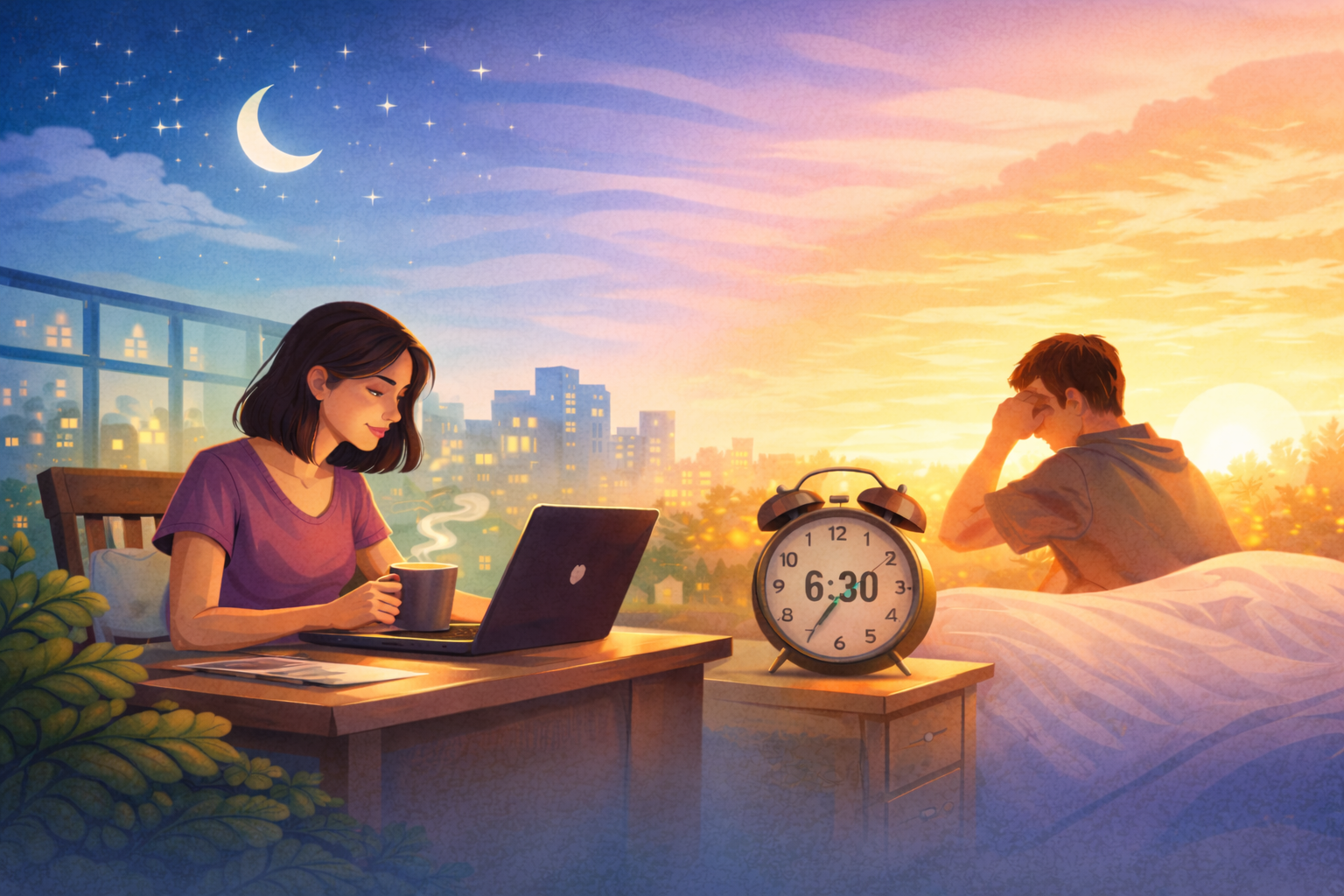
You know the feeling. It’s 10:00 PM, and while the rest of the world is winding down, your brain is just hitting its stride. You’re sharp, creative, and finally "awake." But then 6:00 AM rolls around, and the alarm clock feels like a personal assault.
For many, the struggle with obesity isn't a lack of willpower, it’s a state of internal desynchrony. If you are a "Night Owl" (Evening Chronotype) living in a "Morning Lark" world, you are likely suffering from a biological mismatch that actively sabotages your metabolism. It’s time to start understanding your Chronotype.
Why do "Night Owls" even exist?
Chronotype is a heritable, polygenic trait, meaning your preference for mornings or nights is partially "hardwired" into your DNA through variations in specific clock genes. In large modern population samples, most people fall in the middle, with smaller minorities at the extremes (“definitely morning” or “definitely evening”). For example, in UK Biobank (a community-based cohort with 439,933 adults aged ~40–69), chronotype assessed by a standard self-rating question showed 27.1% “definitely morning,” 63.9% intermediate (split across “more morning” and “more evening”), and 9.0% “definitely evening”. The distribution shifts with age (later during adolescence/early adulthood, earlier with aging) and differs with environment and social constraints, but the “mostly intermediate, fewer extremes” pattern remains consistent.
Being a Night Owl might have saved your ancestors' lives. The Hadza are a conteporary hunter-gatherer community in northern Tanzania whose traditional lifestyle, free from the distortions of electric light and rigid industrial schedules, provides researchers with a vital "natural window" into how human sleep and circadian rhythms evolved. Researchers studying the Hadza hunter-gatherers found that in a typical camp, someone was awake nearly 99.8% of the time. While the "Larks" (morning people) slept, the "Owls" (night people) stayed awake, acting as sentinels to guard against predators. Your late-night energy isn't a "glitch"—it was once a survival gift. The problem isn't your clock; it's that we now live in a world that runs exclusively at "Lark Time."
Social Jetlag
Productivity culture quietly assigns moral value to waking at dawn. The early riser is praised, and the night person is treated as the one who needs “fixing.” The “problem” isn’t being a night person at all—it’s being a night person in a world that runs on morning rules. The problem isn't being an Owl; it's Social Jetlag—the discrepancy between your biological clock and your social obligations (work/school). Your Chronotype (evening person) is basically your body’s timing preference—when sleep feels easiest, when alertness rises, when your internal night begins. One-way researchers measure that internal timing is DLMO (dim-light melatonin onset), the point when your brain begins secreting melatonin under dim light. Later chronotypes tend to have later DLMO on average—meaning their biological night starts later.
Your circadian rhythm is your body’s built-in 24-hour timing system. Think of it as a conductor that keeps thousands of “daily programs” coordinated: when you feel sleepy vs alert, when hormones rise and fall, when digestion is primed, when body temperature peaks, even when immune cells are more active. The master timekeeper sits in the brain, in the suprachiasmatic nucleus (SCN) of the hypothalamus. The SCN gets direct input from the eyes (special light-sensitive retinal cells), so light is the strongest cue that resets the clock each day. From there, the SCN synchronizes the rest of the body through nerves, hormones, and behavior—helping keep peripheral clocks in organs like the liver, pancreas, fat, and gut aligned with the day–night cycle. Melatonin rises in the evening to signal “biological night,” while cortisol typically rises toward morning to support wakefulness and energy mobilization.
Health effects
When an "Owl" is forced to wake up at 6:00 AM, the Brain Clock: Says it’s midnight and time for rest. The Social Clock: Says it’s 6:00 AM and time for school or work. They will experience social jetlag. This isn't just about being tired; it’s a total internal desynchrony leading to health consequences.
Research consistently shows that the evening chronotype is tied to a higher body mass index (BMI) and a more "obesogenic" lifestyle, but the reason isn't necessarily found in the "Owl" genes themselves. Instead, the risk is driven by a series of behavioral shifts that occur when your biological timing is pushed late: shorter sleep, late-night light exposure, and irregular eating. In studies of Mediterranean populations, "late eaters" lost significantly less weight than "early eaters," even when their total calorie intake and physical activity were identical. Late eaters also tended to be more evening-type and more likely to skip breakfast. This suggests that eating when your peripheral clocks (in the liver and gut) are winding down makes you metabolically inefficient. Eating a late-night "second dinner" happens when your pancreas is "asleep," leading to poor glucose control and increased fat storage. Misalignment blunts the morning cortisol surge and disrupts appetite hormones (Leptin and Ghrelin), making you crave high calorie, "ultra-processed" foods at night.
When your sleep schedule swings by more than two hours between your work week and your weekend, you aren't just tired; you are statistically 1.3 to 1.7 times more likely to struggle with obesity. For the typical "Owl," this often happens. Furthermore, definite evening" types face a 15–25% higher hazard of cardiovascular events and 1.5 to 1.8 times higher odds of depression, and a BMI that is 0.3 to 0.6 kg/m² higher than their morning-oriented peers.
A lot of studies link eveningness to cardiometabolic and mental-health risks. Much of the observed risk is plausibly driven by repeated exposure to sleep restriction, circadian phase misalignment, and behavior timing shifts (late eating, reduced morning light, inconsistent activity), rather than the chronotype trait itself. The takeaway is your chronotype is not a pathology. The harm stems from misalignments, which is a modifiable factor.
If it’s misalignment, what helps?
There is no need to change who you are. Modern life floods evenings with light and often deprives us of morning light. The goal is not to turn an owl into a lark. The goal is alignment.
1- Use light strategically. Light is the main clock-reset tool. In a famous natural light experiment, adults who spent one week camping without artificial light shifted their circadian timing earlier — especially those who were later chronotypes. Light expands or shrinks the owl-lark gap. Get 15–30 minutes of outdoor sunlight as soon as you wake up which can help "pull" your rhythm earlier, making it easier to fall asleep at night. Moreover, your brain thinks the blue light from your phone is the sun. Dim your lights and use filters after 8:00 PM to allow melatonin to rise naturally.
2- Stabilize wake time. The biggest mistake is "catching up" on sleep by 4 hours on the weekend. This creates a permanent state of jetlag. Try to keep your weekend wake time within 60 minutes of your weekday alarm.
3- Watch your eating habits. If you’re an evening type, evenings are often your highest-risk window for cravings. Plan it: a structured high-protein snack before cravings hit, a “kitchen closing” routine or a default if-then plan (“If I want something at 10 pm → I have X.”)
“Don’t eat late” is not about 8 p.m. or 9 p.m. It’s about your biological night. Your body shifts into night mode when melatonin — your sleep hormone — starts rising. For most people, that happens somewhere between 8:00 and 10:30 p.m., but it depends on your chronotype. When you eat close to that internal night, your body handles glucose less efficiently. Blood sugar rises higher. Insulin works less effectively. The same meal eaten earlier in your biological day produces a better metabolic response. Finish your last main meal 2–3 hours before your natural bedtime. Keep your evening timing consistent throughout the week.
Conclusion
Chronotypes likely exist for deep-seated biological and evolutionary reasons—ranging from your genetic "wiring" to the protective "sentinel" roles humans played in ancestral groups. However, modern life, with its early-morning schedules, artificial bright nights, and late-night eating, forces certain chronotypes to pay a much higher physiological price.
The JA Method shifts the conversation away from the frustrating attempt to "fix" your nature. Instead of asking, “How do I force myself to become a morning person?” the focus becomes: “How do I reduce my internal misalignment and protect my highest-risk hours?” By identifying those windows where your biology and your environment clash, you can stop the metabolic friction. That strategic alignment is where real health wins—and sustainable weight management—actually live.
References
- Arab, A., Karimi, E., Garaulet, M., & Scheer, F. A. J. L. (2024). Social jetlag and obesity: A systematic review and meta-analysis. Obesity Reviews, 25(3), e13664. https://doi.org/10.1111/obr.13664
- Garaulet, M., Gómez-Abellán, P., Alburquerque-Béjar, J. J., Luján-Antequera, S., Ordovás, J. M., & Scheer, F. A. J. L. (2013). Timing of food intake predicts weight loss effectiveness. International Journal of Obesity, 37(4), 604–611. https://doi.org/10.1038/ijo.2012.229
- Jones, S. E., Lane, J. M., Wood, A. R., van Hees, V. T., Tyrrell, J., Beaumont, R. N., Jeffries, A. R., Dashti, H. S., Hillsdon, M., Ruth, K. S., Tuke, M. A., Yaghootkar, H., Sharp, S. A., Jie, Y., Thompson, W. D., Harrison, J. W., Dawes, A. S., Budd, C. L., Lewis, D. A., . . . Weedon, M. N. (2019). Genome-wide association analyses of chronotype in 447,678 individuals identifies new loci and genetic links with self-reported diurnal preference and mental health. Nature Communications, 10(1), 481. https://doi.org/10.1038/s41467-018-08259-7
- Kennaway, D. J. (2023). The dim light melatonin onset: What it is and what it is not, and its relationship with morningness/eveningness. Sleep, 46(5), zsad033. https://doi.org/10.1093/sleep/zsad033
- Lotti, S., Pagliai, G., Colombini, B., Sofi, F., & Dinu, M. (2022). Chronotype differences in energy intake, dietary quality, and meal timing: A systematic review with meta-analysis of observational studies. Advances in Nutrition, 13(6), 2239–2252. https://doi.org/10.1093/advances/nmac075
- Malone, S. K., Patterson, F., Lu, Y., Lozano, A., & Hanlon, A. (2016). Ethnic differences in sleep duration and morning–evening type in a population sample. Chronobiology International, 33(1), 10–21. https://doi.org/10.3109/07420528.2015.1107722
- Neves, A. R., Albuquerque, T., & Quintela, T. (2022). Circadian rhythm and disease: Relationship, new insights, and future perspectives. Journal of Cellular Physiology, 237(10), 3737–3758. https://doi.org/10.1002/jcp.30815
- Parsons, M. J., Moffitt, T. E., Gregory, A. M., Goldman-Mellor, S., Nolan, P. M., Poulton, R., & Caspi, A. (2015). Social jetlag, obesity and metabolic disorder: Investigation in a cohort study. International Journal of Obesity, 39(5), 842–848. https://doi.org/10.1038/ijo.2014.201
- Kianersi, S., Potts, K. S., Wang, H., Sofer, T., Noordam, R., Rutter, M. K., ... & Huang, T. (2026). Chronotype, Life’s Essential 8, and risk of cardiovascular disease: a prospective cohort study in UK Biobank. Journal of the American Heart Association, 15(3), e044189.
- Wright, K. P., McHill, A. W., Birks, B. R., Griffin, B. R., Rusterholz, T., & Chinoy, E. D. (2013). Entrainment of the human circadian clock to the natural light-dark cycle. Current Biology, 23(16), 1554–1558. https://doi.org/10.1016/j.cub.2013.06.039


